

Climbing over the side of an F1 simulator in Maranello, a stranger’s hand holding the halo out of the way, then strapped in and staring down the Imola pit straight, I was fairly convinced a Scuderia contract was about to change my life. It didn’t. But that one ridiculous, brilliant moment was as good a snapshot as any of the four weeks that followed: ancient cities, fast cars, more gelato than is strictly reasonable, and a fair bit of chaos we hadn’t planned for. It started, as these things do, on a cool morning in Rome.
Rome
We landed in Rome on a cool morning in early spring. The sun was shining bright but there was still a bit of a chill in the air as we explored our first morning in the historic centre of Rome. Due to a late change in flight arrangements, we had an additional day to spend in Rome at either end of our trip, which meant we had to book an additional night in a different hotel.
We arrived at the Coronari Palace Hotel around 10:00am, but with a check-in time of 4:00pm we had time to explore first. The reception staff were extremely helpful, even offering us a coffee and somewhere to sit while we planned our day, before we set out to explore Rome.
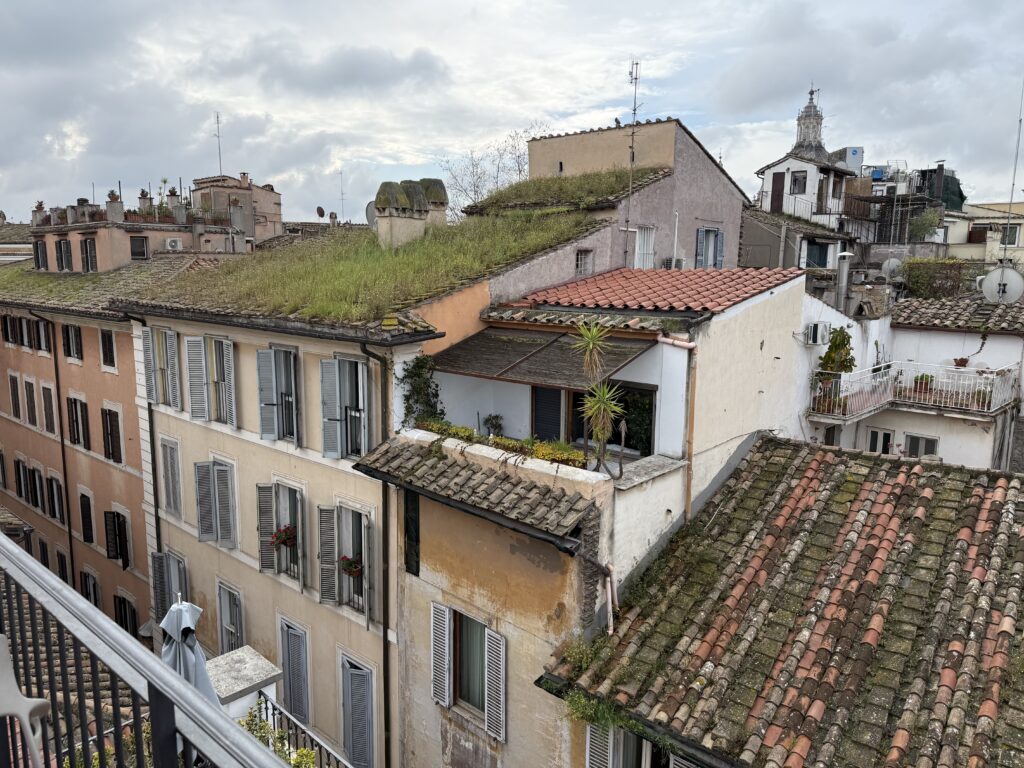
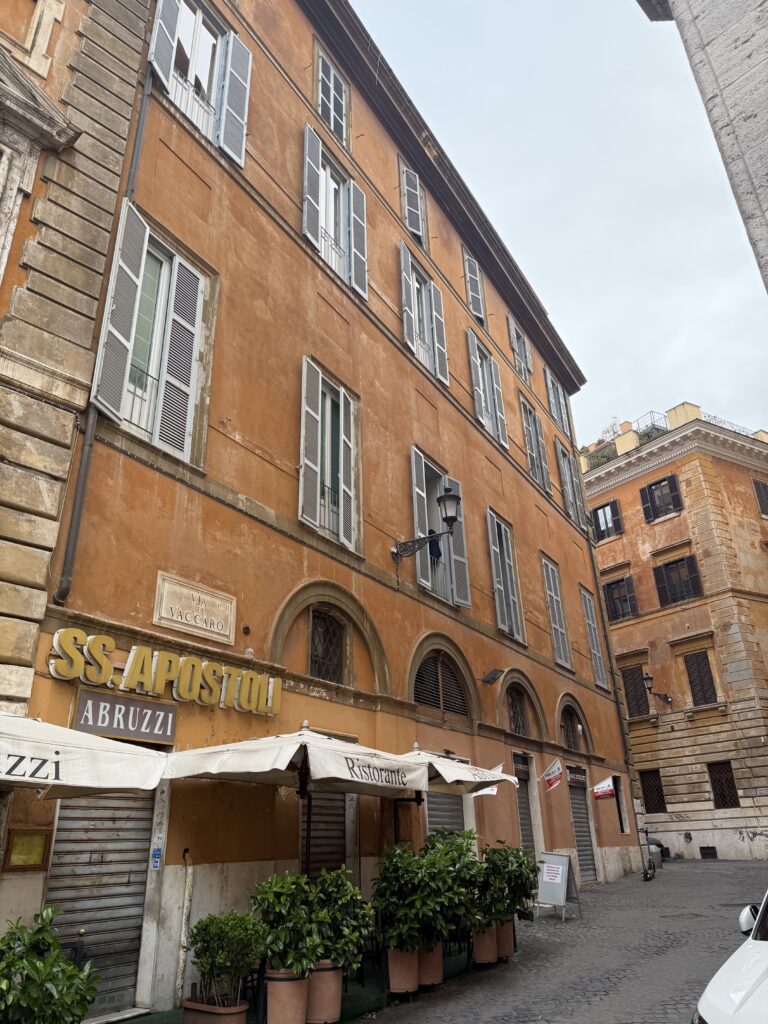
We stepped out onto the cobblestoned roads and started exploring the ancient architecture around our hotel. Being in the historic centre meant that many of the surrounding buildings were well over 700 years old. It’s a real contrast to what we’re used to in Australia where we have few buildings over 150 years old, let alone an entire city that dates back thousands of years.
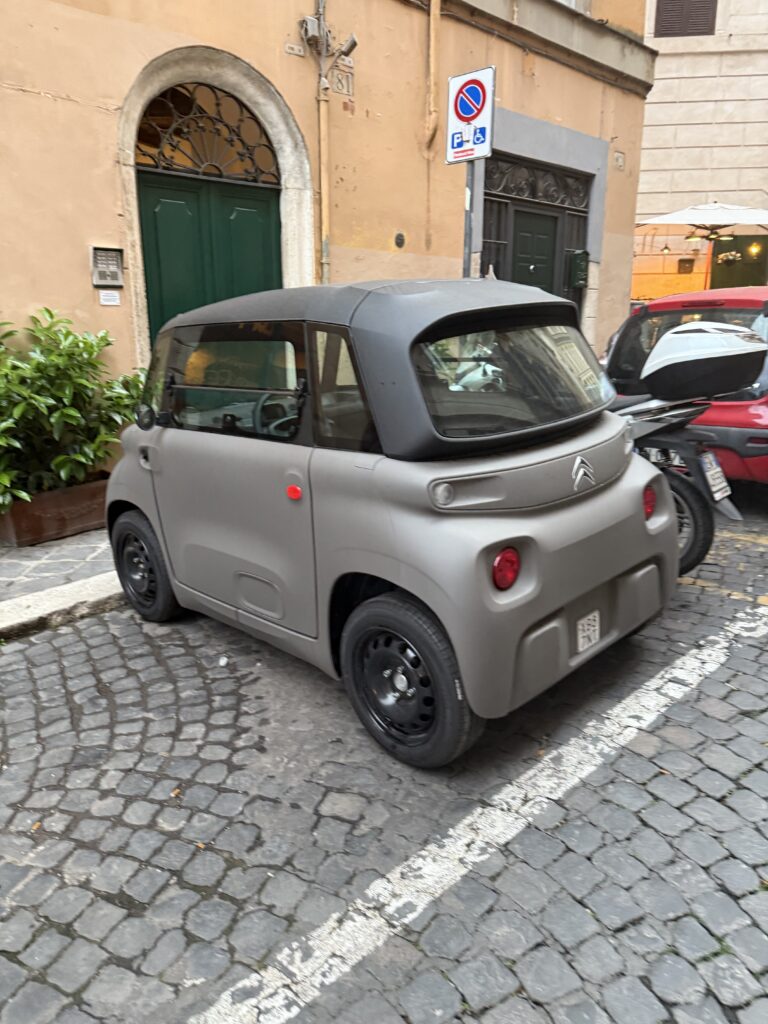
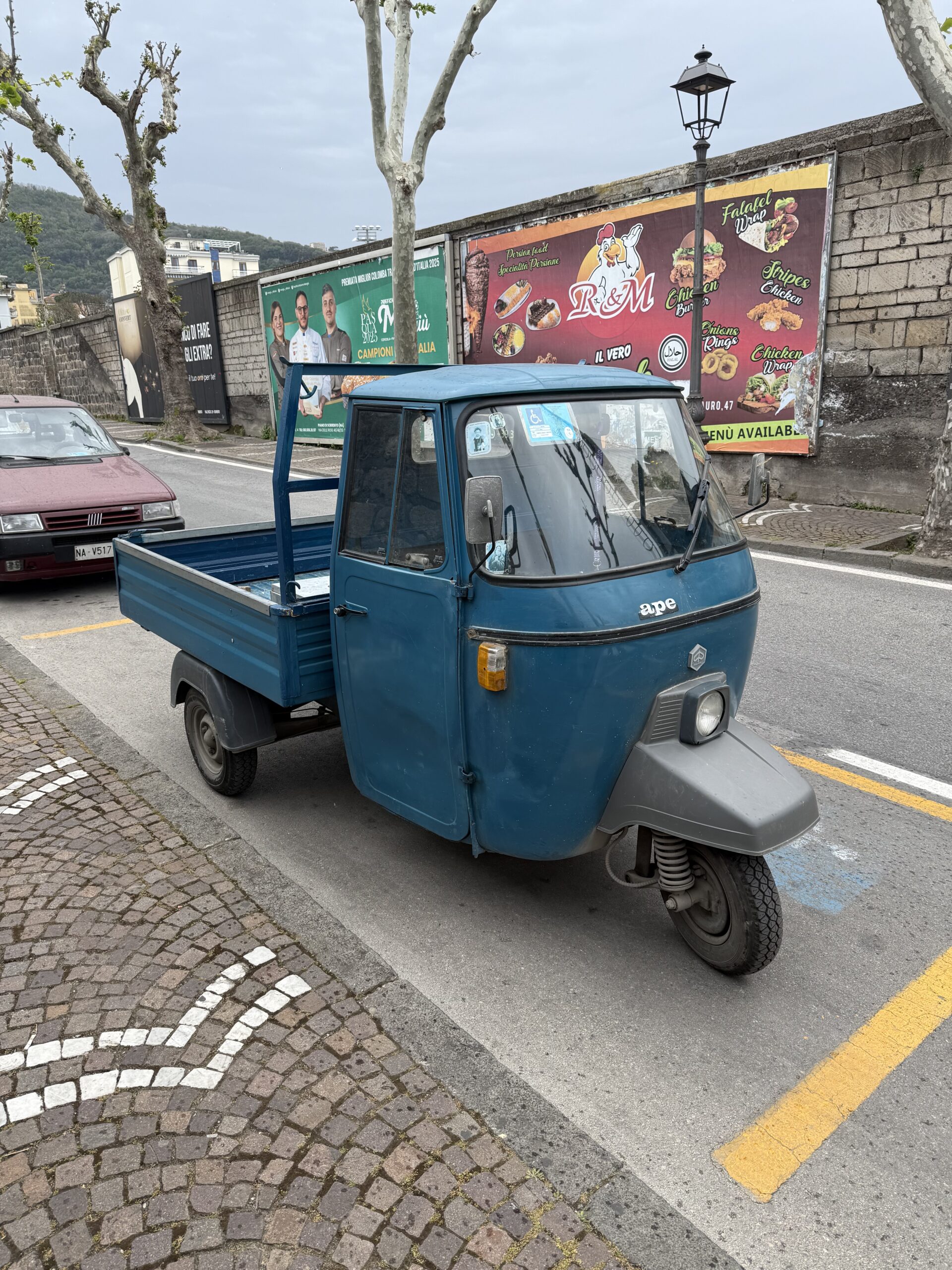
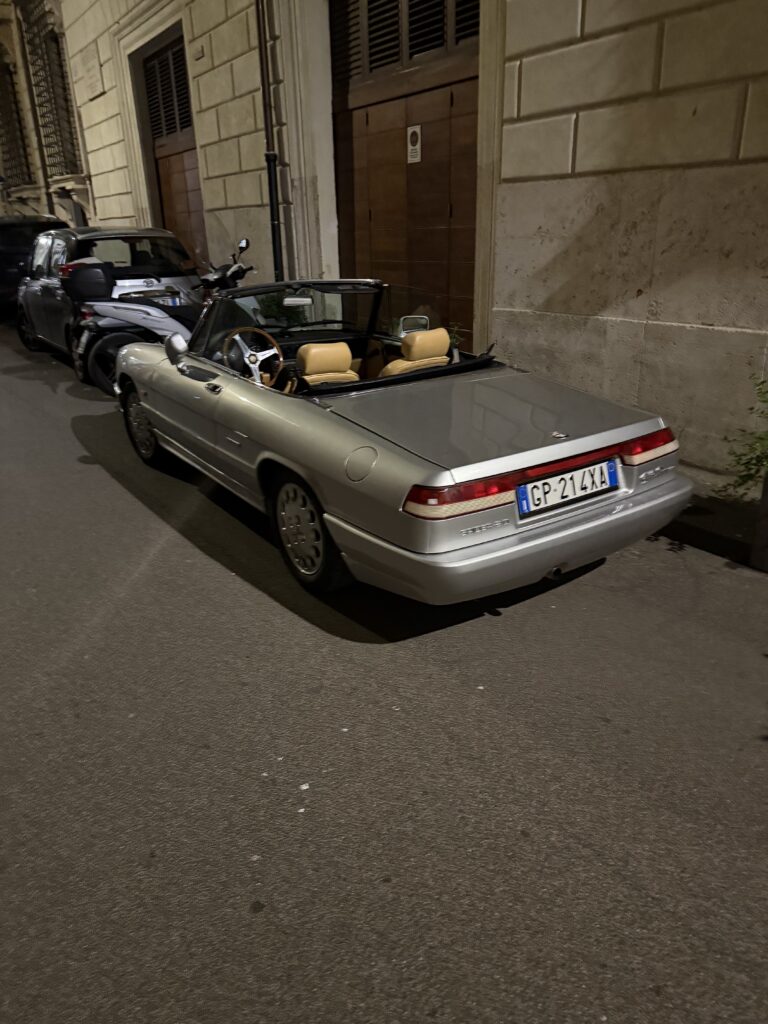
As a motoring enthusiast, it was also quite interesting to see many of the microcars in Rome that are parked up in the tight alleyways that make up the Roman road network. Many of the microcars were wider than they were long, so it wasn’t uncommon to see them parked up perpendicular to the kerb where other cars were parallel parked.




We continued our exploration of Rome and headed towards Castel Sant’Angelo. Castel Sant’Angelo, also known as the Mausoleum of Hadrian, is a historic structure in Rome with a fascinating past. Built between 123 and 139 AD, it was originally commissioned by Emperor Hadrian as a mausoleum for himself and his family. Over the centuries, it transformed from a tomb into a fortress, a papal residence, and even a prison. Its name, “Sant’Angelo,” comes from a legend in 590 AD, when the Archangel Michael is said to have appeared atop the castle, signaling the end of a plague in Rome.
Today, it stands as a museum, offering visitors a glimpse into its layered history and architectural evolution. It’s also connected to the Vatican by a secret passageway, the Passetto di Borgo, which was used by popes during times of danger. Quite the storied landmark!




Following this we had dinner at one of the local restaurants and headed back to Coronari Palace. We checked in and settled into our delightful room. Travelling with two young kids aged 7 and 10 meant that there were no late nights for us, so we didn’t really get to explore much of the nightlife.
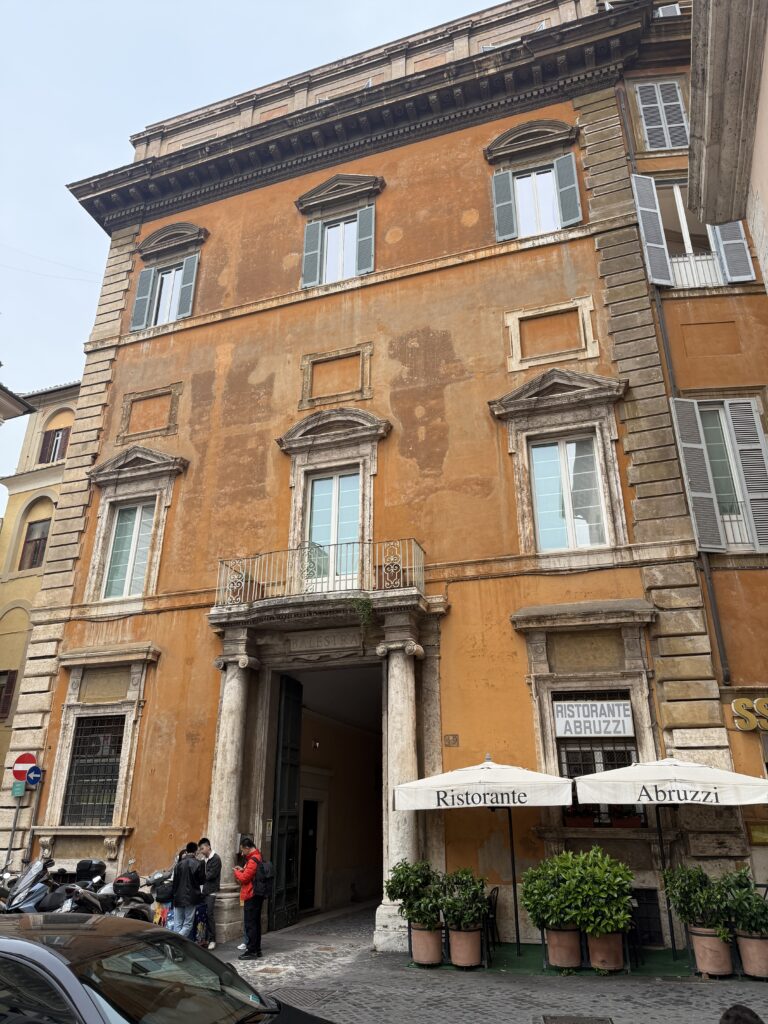
The next morning saw us check out of the Coronari Palace and head to our next accommodation – an Airbnb in the building known as Palazzo Balestra. Tracing its history back to the Renaissance period, it was originally constructed as a noble residence and has undergone various transformations over the centuries. The building is notable for its architectural elegance and its connection to the Balestra family, who were prominent figures in Roman society.
At one point it housed the son of King James II of England and Mary of Modena. It’s said that after his father’s deposition he claimed the thrones of England, Scotland and Ireland, and was supported by the Pope, who housed him and his family in Palazzo Balestra. Being such an ancient city, many buildings in Rome are filled with colourful back stories like this.
Fittingly, given our lodgings’ Papal ties, one of our days took us across to the Vatican – a visit that meant a little more to us than the average tourist stop, since as a Coptic Christian family, faith and history travel with us wherever we go. We spent hours working our way through the Vatican Museums, room after room of it, the sheer scale of what was on display almost too much to take in – tapestries, sculpture, painted ceilings everywhere you looked, all building towards the Sistine Chapel. And nothing quite prepares you for stepping into that room and looking up at Michelangelo’s ceiling. We weren’t allowed to take any photos in there, which was frustrating at first, but in a way it forced us to simply stand and take it in rather than viewing it through a screen – probably no bad thing.
Standing there with my neck craned back at Michelangelo’s ceiling, I couldn’t help thinking of a story about the fresco I’d read somewhere and never quite forgotten. When Michelangelo was finishing The Last Judgment on the altar wall – decades after he’d done the ceiling – the Pope’s Master of Ceremonies, a priest named Biagio da Cesena, took one look at all the nude figures and complained that the painting was more suited to “the public baths and taverns” than a papal chapel. Michelangelo’s response was to paint Biagio’s face onto Minos, judge of the underworld, tucked into the bottom corner of the fresco, complete with donkey ears for good measure. When Biagio complained to the Pope, he was reportedly told that his jurisdiction didn’t extend to Hell, so the portrait was staying exactly where it was.
It gets better. Restorers cleaning the fresco a few decades ago discovered that the snake wrapped around Minos isn’t just covering him up – it’s biting him somewhere rather personal. Nearly 500 years later and Michelangelo is still getting the last laugh in front of thousands of visitors a day. Fittingly, given the whole day had a Papal theme to it, this was the story I found myself telling my kids while we stood in the Sistine Chapel, minus a few of the finer details.
From there we went on to St Peter’s Basilica, and its sheer size takes your breath away once you’re inside – vast, and every surface worked in marble, gold or mosaic. Beneath the church we descended into the grottoes, a quieter, dimmer world after the grandeur above, where generations of popes lie entombed. There was something humbling about moving through that low, hushed space, so close to figures who had shaped centuries of history, with the great Basilica pressing down overhead.


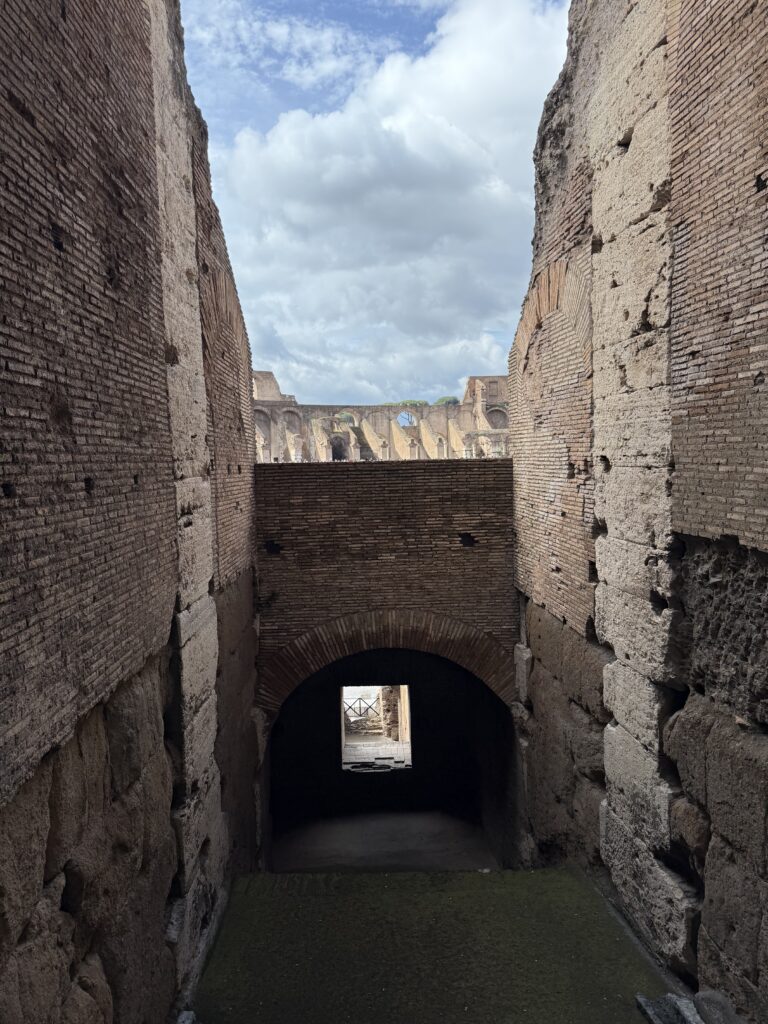
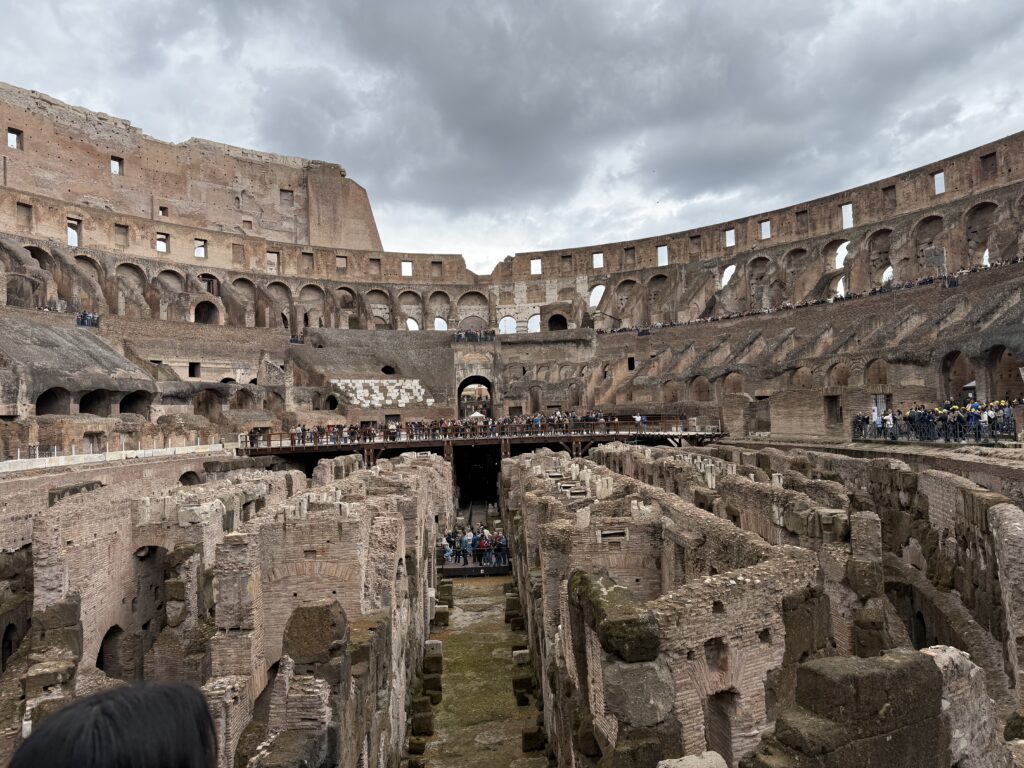
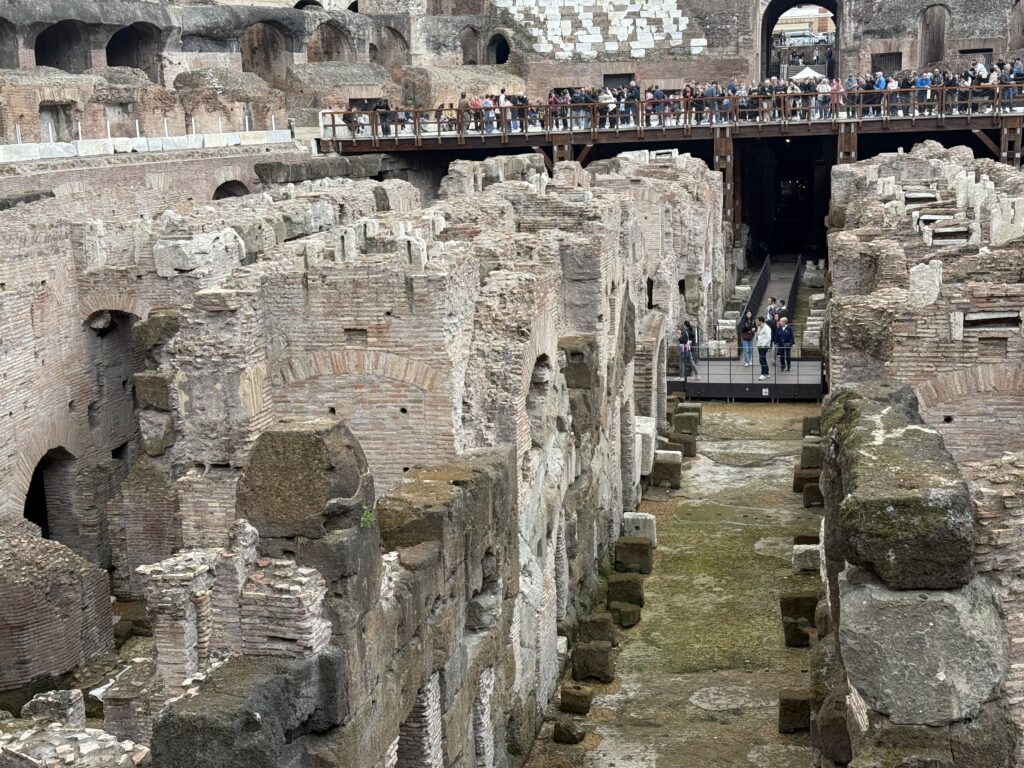
We explored Rome for a few more days enjoying many of the major tourist attractions – The Colosseum, Palatine Hill, the Trevi Fountain – completely in awe of what we were seeing, before packing and making our way to our next stop – Venice.










Venice
To get to Venice we took the Trenitalia Frecciarossa train. Most of the major cities in Italy are joined together by a high speed train network. Our train reached speeds of 285km/h getting us through the 531km journey to Venice in 2 hours and 30 minutes.


Much like our stay in Rome we were once again in awe as we arrived in Venice. We checked into our accommodation at the Aqua Palace and worked through the usual tourist checklist – St Mark’s Square, the Bridge of Sighs, Doge’s Palace (though we didn’t go inside), plenty of gelato, a gondola ride, and a guided tour of Murano and Burano – the full stereotypical tourist experience.
While in Venice we had a very methodical way of choosing places to eat – We looked for restaurants with names of our kids! We enjoyed what was undoubtedly one of the best gelatos we had on this trip at Suso Geloteca (Suso being my daughter Sophia’s nickname), we experienced fine dining at Trattoria da Jonny, and a casual dinner at Trattoria da Gigi (my wife’s nickname).


Milan, Lake Como and a Dash into Switzerland
We were now 9 days into our journey and still running on adrenaline and high serotonin levels when we took our second high speed train to Milan. This is where we planned to pick up our hire car so we could travel to our own schedule – but before I get to that, let’s talk a little about Milan. Internationally it’s known as a fashion and design hub, but in real life it felt a little lacklustre. The architecture was a mix of ultra-modern glass high rises intermixed with some 19th century apartments, and after Rome and Venice it was all quite underwhelming. But we weren’t in Milan for Milan – we planned to use it as a base for heading out to Lake Como, Bellagio and Switzerland. We were lucky to have temperatures in the low 20s while we were there, which for me means shorts and a T-shirt, though for the locals long pants and thick coats were the norm. You could easily tell we were the tourists.
We had pre-booked a Mercedes-Benz GLE for the main leg of our travels, but a last-minute shake-up of our plans meant we needed a car a couple of days earlier than expected. We’d booked the Mercedes through a car rental brokering website, which has a rather clever approach to rental insurance. Like most brokers, they offer a wide range of cars from all the usual rental companies, but the real difference is the insurance, which they provide at a significant discount.
Here’s how it works. When you rent directly through a rental company, they’ll typically sell you a zero-excess insurance policy, but it can easily double the base price of the rental. That’s because in a serious accident the insurer has to cover the cost of the car, third-party liability and any other damage – potentially millions. Rent at the base price instead and you have the same coverage, but with a hefty excess if you make a claim: in our case, €3,000 for an accident or €3,500 for theft. What the broker does is cover the excess only – up to €10,000 for a couple of hundred dollars over the whole 14-day rental. If anything happens, you pay the excess, then claim it back. Plenty of credit cards and travel insurers offer something similar.
The catch was that it was too late to change our rental dates through the broker. The Mercedes was available to collect directly from the rental company for those two extra days, but rather than risk it affecting the terms of our discounted insurance, we opted to rent a separate car just for the first couple of days. That turned out to be a Lexus UX – a tidy little hybrid hatchback, and more than enough for what we needed, since these first couple of days would be day trips out to the lakes without any luggage to worry about.
As it turned out, the Lexus was the right car for these early days. Its compact size worked far better on the narrow streets of Milan and around Como, particularly as we headed towards Bellagio, where some stretches of two-way road were too tight for two cars to pass. Bellagio itself was a lovely little town on Lake Como with a very up-market feel, though I’ll admit it didn’t do a lot for me. Maybe it was just the small corner we sampled in the few hours we had there, but I far preferred clambering over ancient Roman ruins to wandering yet another pretty coastal town. Still, we made the most of it – a few hours exploring, a bit of shopping, and the obligatory gelato – before buying a ferry ticket across to the other side of the lake.
We crossed to Menaggio in the mid-afternoon, and to our relief the roads on that side were far kinder than the pinched, winding lanes we’d taken into Bellagio. From there we pointed the Lexus north and slipped across the border into Switzerland for a look at Lugano. The change was immediate – the lazy, sun-warmed Italian lakeside giving way to something noticeably crisper and more orderly the moment we crossed over. Lugano sits on its own lake, ringed by steep green mountains, with an unmistakably Swiss neatness to it despite everyone still speaking Italian. We spent a little while taking it in before making the drive back to our base in Milan.
With the lake trips behind us, it was time for the car we’d actually come for. We returned the Lexus and finally picked up the Mercedes GLE, and it didn’t disappoint. Ours was the GLE 350d – a diesel hybrid finished in black, with the AMG package that gave it a purposeful, slightly menacing look. Bigger and far plusher than the little Lexus, it felt like exactly the right car for the serious driving still ahead of us: the long autostrada hauls, the mountain passes, and the road south through Italy that we had planned.
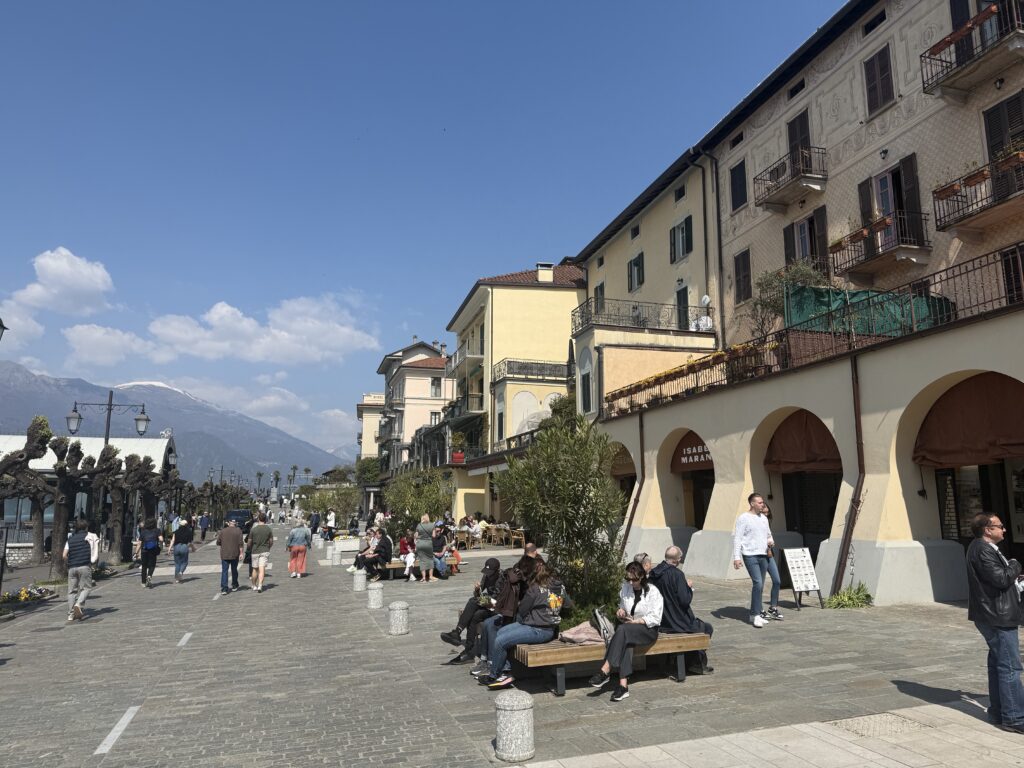
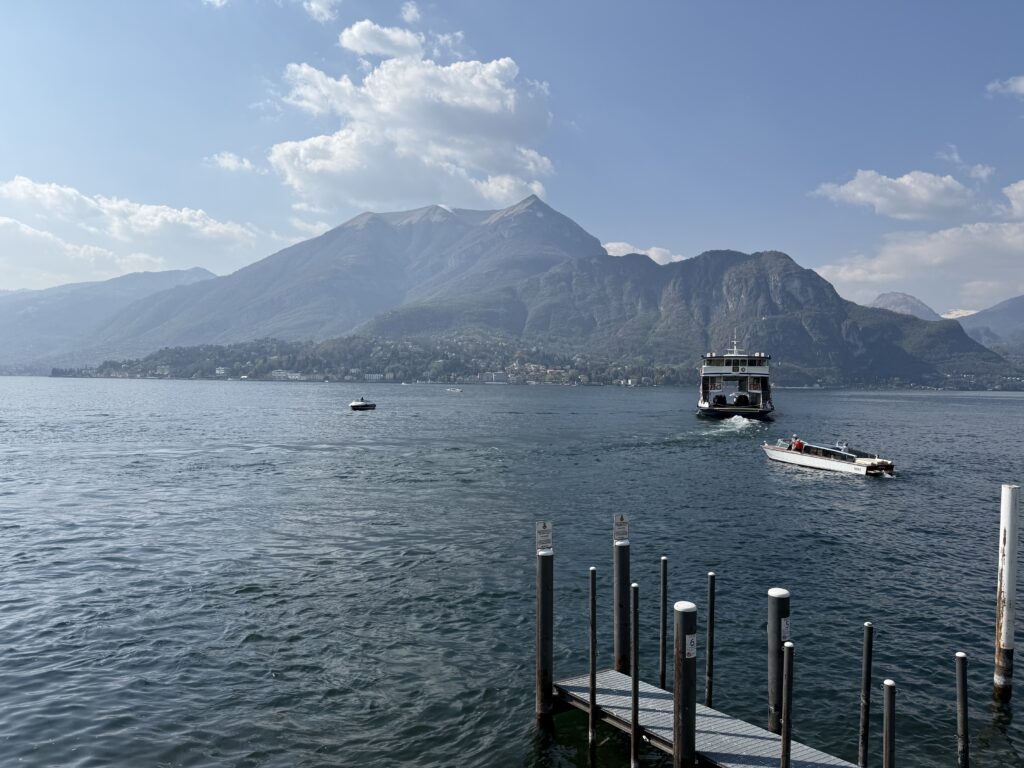


The following day we made an early start and headed for Lugano, Switzerland. Lugano is on the southern end of Switzerland not far from the Italian border and they speak Italian there. We spent our day on the coast and it was clear that this part of Lugano was a playground for the wealthy. We had lunch at a lovely restaurant by the bay enjoying the seafood. Of course the kids wouldn’t eat anything off that menu so we took them to what may be the fanciest McDonalds I’ve ever been to – 2 cheeseburgers, nuggets and 2 cokes – CHF45.50 – about $80AUD.


I mentioned that Lugano was a playground for the wealthy and that meant, it was an amazing place for car spotting. My young son was sitting by my side pointing and counting all of the Ferraris, Lamborghinis and McLarens passing by along with the odd classic including this lovely 280SE 3.5 Coupe that was casually making its way through town.


We spent a little more time enjoying sights and sounds of Lugano before heading back to Milan, where we did have a slight mishap with the Lexus. I managed to clip the mirror on a wall, but fortunately the damage was only limited to a minor scratch. Fortunately I had full insurance coverage on this car so they accepted the car without inspection and let us go. I had read online that this rental company likes to go over the car with a microscope on return, so that was quite a relief.
The next morning we picked up our Mercedes. This was to be our transport for the next 14 days. A 2024 Mercedes-Benz GLE350d. A plug-in hybrid, although we surprisingly received it with 0% charge on the hybrid battery. We went with the GLE as we were planning on using it as a main mode of transport for travelling between towns. This meant plenty of highway driving and space for our luggage, so I was a little disappointed to receive the coupe version. Luckily with careful stacking we were able to just squeeze our 6 luggage bags into the car (2 large suitcases and 4 hard carry-ons – we don’t travel light!). While it was a new and low mileage car, there was plenty of evidence of it being used as a rental car before we received it with lots of small marks and gutter rash on the wheels. I took plenty of photos before accepting the key and signing off on it.
Modena: Ferrari, Lamborghini and Pagani
We then made our way to Modena. There was no way I was traveling to Italy and not getting some time to explore the hometown of the most famous automotive marques in the world. This modest province of the Emilia-Romagna region of Italy is home to Ferrari, Lamborghini and Pagani. I had to go visit their museums!
We travelled from Milan to Modena on the Autostrade, sticking as closely as possible to the 130km/h speed limits. The last thing I wanted was to get a speeding ticket in a foreign country. Meanwhile I was constantly being passed by cars going far quicker than I was – usually by cars with Swiss number plates. I decided, when in Rome, do as the Romans (or in this case the Swiss) do and went with the flow and slow down when they do or when I saw a speed camera sign.
Where the GLE really came into its own was comfort. Even with the speedometer climbing, the ride stayed remarkably calm and settled, and there was enough room inside that nobody felt cramped on the long haul. It never felt like it was working hard – power was always there when I wanted it, but it was happy to just lope along at a cruise. For the kind of distances we were covering on the Autostrade, I couldn’t have asked for a better car.
A couple of hours later we arrived in the centre of Modena. In Modena we needed to be extra careful as they have ZTL or Zona a Traffico Limitato (Limited Traffic Area) zones with hefty fines for entering them with a car. Fortunately our Airbnb host had arranged parking for us and given us explicit instructions on where we can and can’t go in Modena. Although we had these careful instructions, it still felt like we were doing the wrong thing in some places as pedestrians were walking in the middle of the road and we had to carefully navigate our way to our apartment.
That night we went out for dinner. I did my best to avoid the over-crowded tourist places and found a lovely little restaurant online that was only a 15 minute walk away. Equipped with google maps and a poor sense of direction we arrived in a leisurely 45 minutes. We must have walked past it three times before we eventually found it – Taverna Dei Servi. A literal hole in the wall where I had to duck my head to get through the door. But the moment we stepped inside, we knew we’d found somewhere special.
It was the atmosphere that got us first. The place was tucked away under these old whitewashed vaults, cool and quiet in the way only really old buildings are, with bits of exposed brick here and there that made it feel like it had a bit of history behind it. Nothing flashy – just white tablecloths, dark wooden chairs and worn terracotta tiles – but somehow it all felt right.
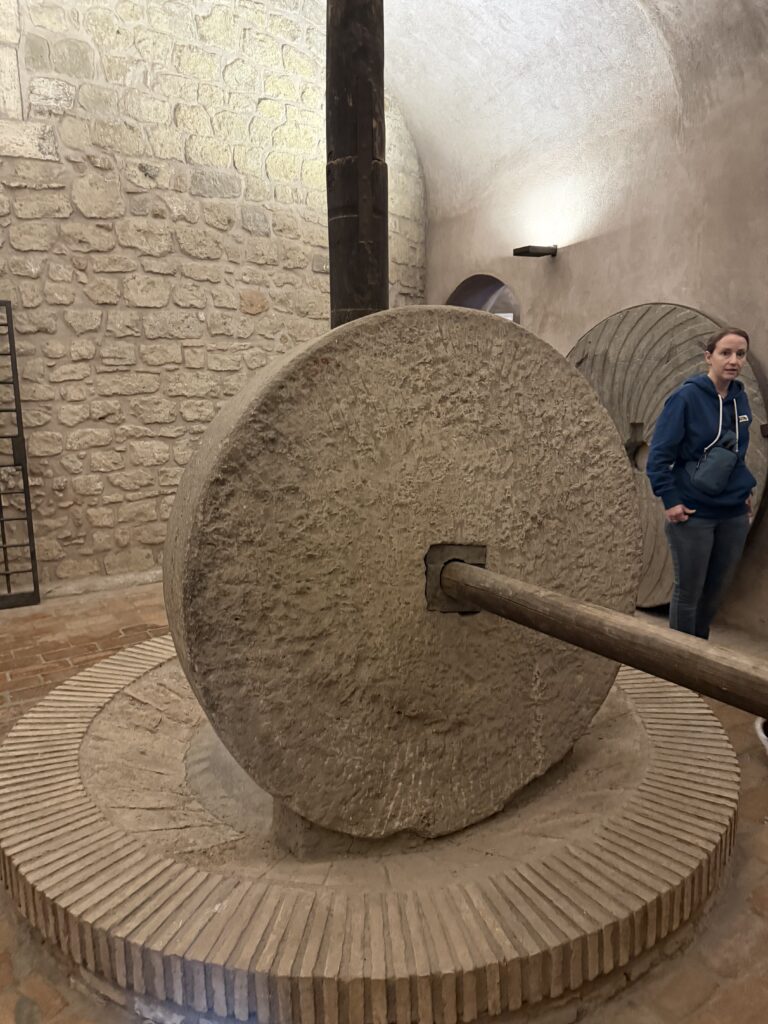
And you could tell straight away that wine mattered here. There was an old press sitting near the door and racks of bottles along the back wall, and it had that proper family-run feel – the kind of place that puts everything into the food and the wine and doesn’t much worry about the rest. And the food lived up to it: honestly the best we had on the whole trip. Modena surprised us that way. It felt calmer than anywhere else we’d been, safer too. Back in Milan there’d been drunks and homeless people around the train station just down from our apartment – we even watched one man get arrested while we were out getting groceries. That was almost comical, actually: as the police moved in, he pulled out a red card and held it up at them like a soccer referee. But here in Modena there was none of that. Just quiet streets, good food, and somewhere you were in no hurry to leave. We felt perfectly safe late at night wandering through the alleyways.


The next 2 days were all about Italian cars! We had planned to go to the 2 Ferrari Museums, Lamborghini and Pagani. They were all relatively close to each other and having our own transport meant we weren’t restricted when we could go.
Our first car museum was Pagani. The Pagani museum is the smallest of the 3 museums, with everything pretty much in a single room. Half a dozen cars on display with some engines on stands. Now these engines may look familiar to some of the Mercedes faithful.
[Mercedes AMG Pagani engines]


How do I get one of these into my C107?
What makes Pagani different to the others though is the attention to detail that goes into every car they build. Paganis aren’t built on a regular production line, they’re all effectively bespoke hand-built cars.


Our ticket also included a tour of the factory, but before we could enter they handed us each a key to a locker where we had to leave our phones, cameras, etc. So unfortunately I didn’t get to take any photos.
They took us through the factory, 1 station at a time, showing us how the chassis is built, the 4 autoclaves (including the original autoclave that Horacio Pagani purchased with his own money when he was working at Lamborghini). We could see the rolls of resin-impregnated carbon fibre ready to be cut up and moulded and finally the service and repair centre. When you own a Pagani, you don’t get a local mechanic to service it – it’s literally shipped back to the factory from wherever you are in the world, where it’s serviced and repaired by their technicians. It is after all a $10M+ car. No matter how badly damaged a Pagani becomes, they can repair it and get it back on the road.
While we were in the service department I happened to notice a lovely ice blue Pagani Huayra Codalunga waiting to be serviced. I can’t say for sure it was this exact car, but OMG! I need this in my life.


The following day we visited the Ferrari museum, which is actually 2 museums at 2 different locations and a shuttle bus between them. There’s the Enzo Ferrari museum in Modena that’s dedicated to the life and history of Enzo Ferrari and then there’s the Ferrari Museum in Maranello which has a greater focus on the actual cars.


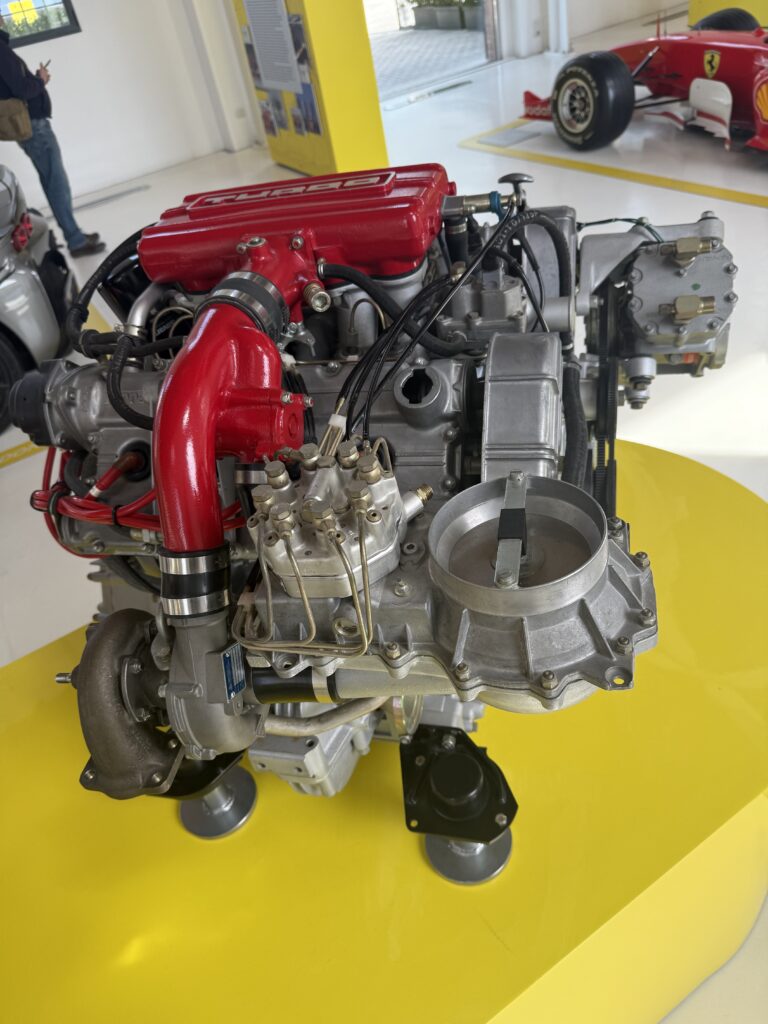


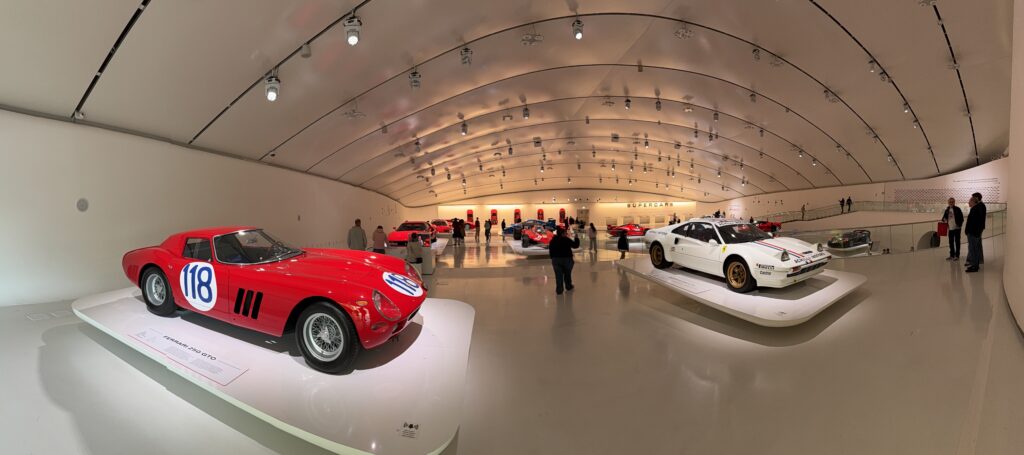

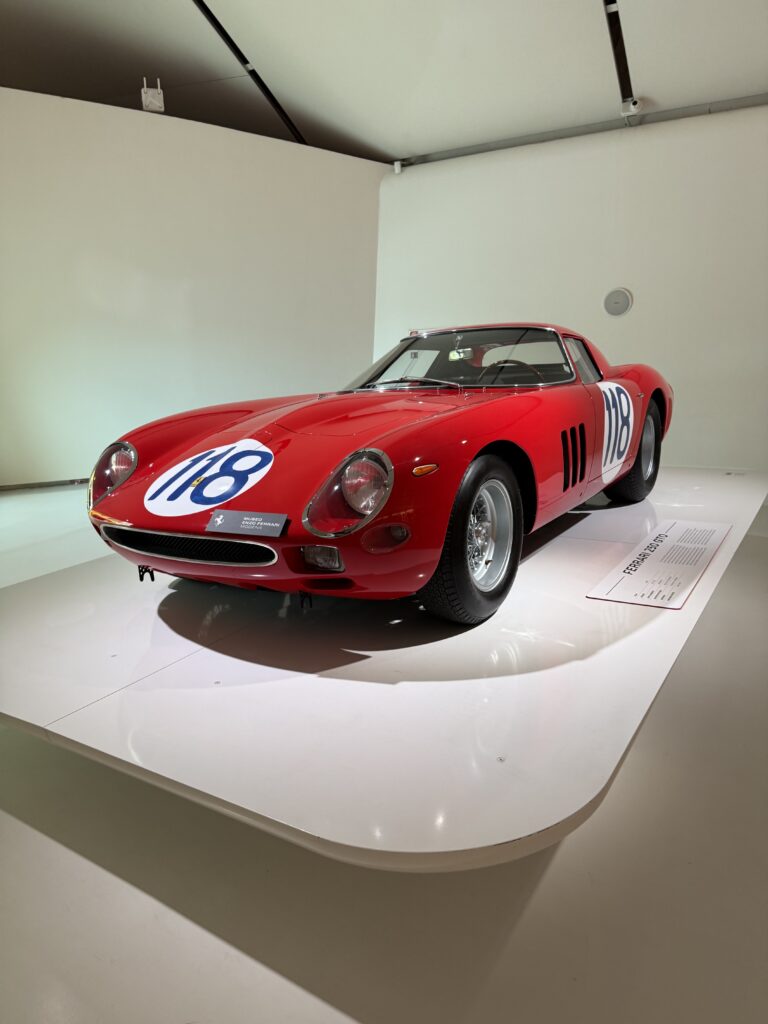


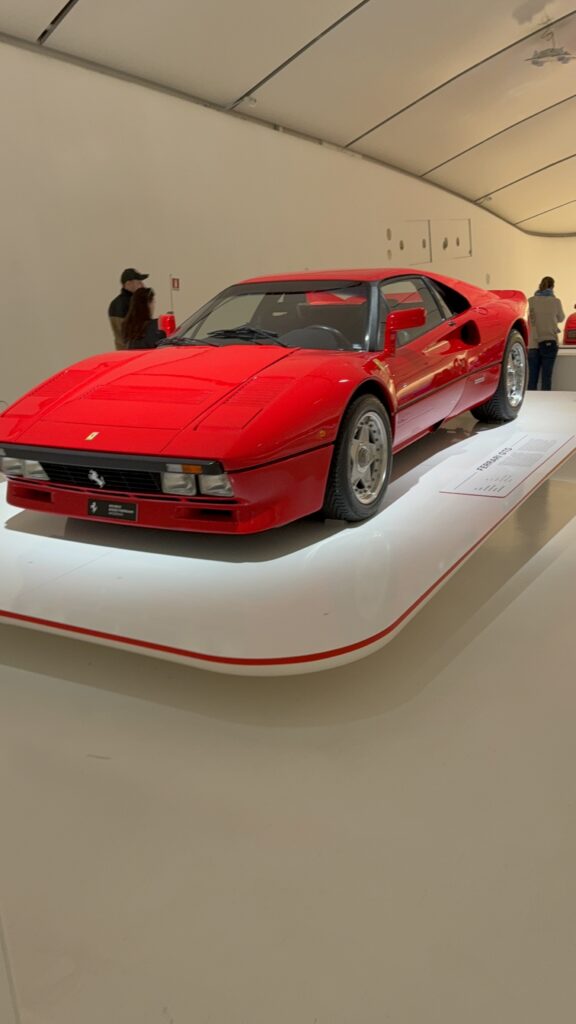

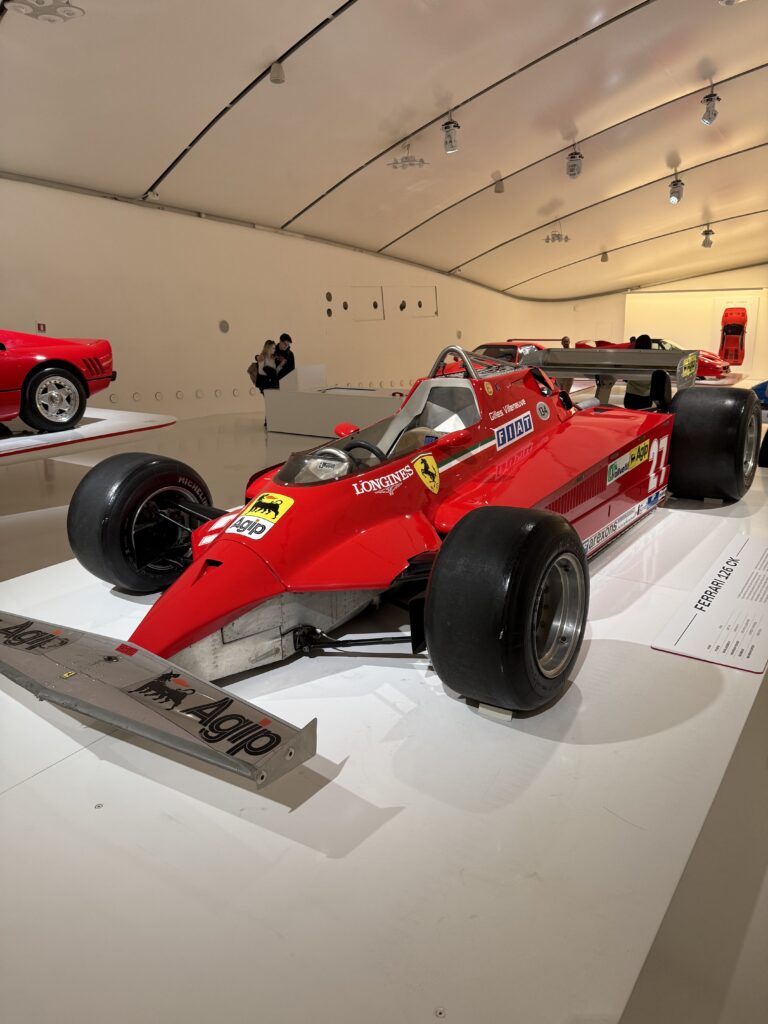


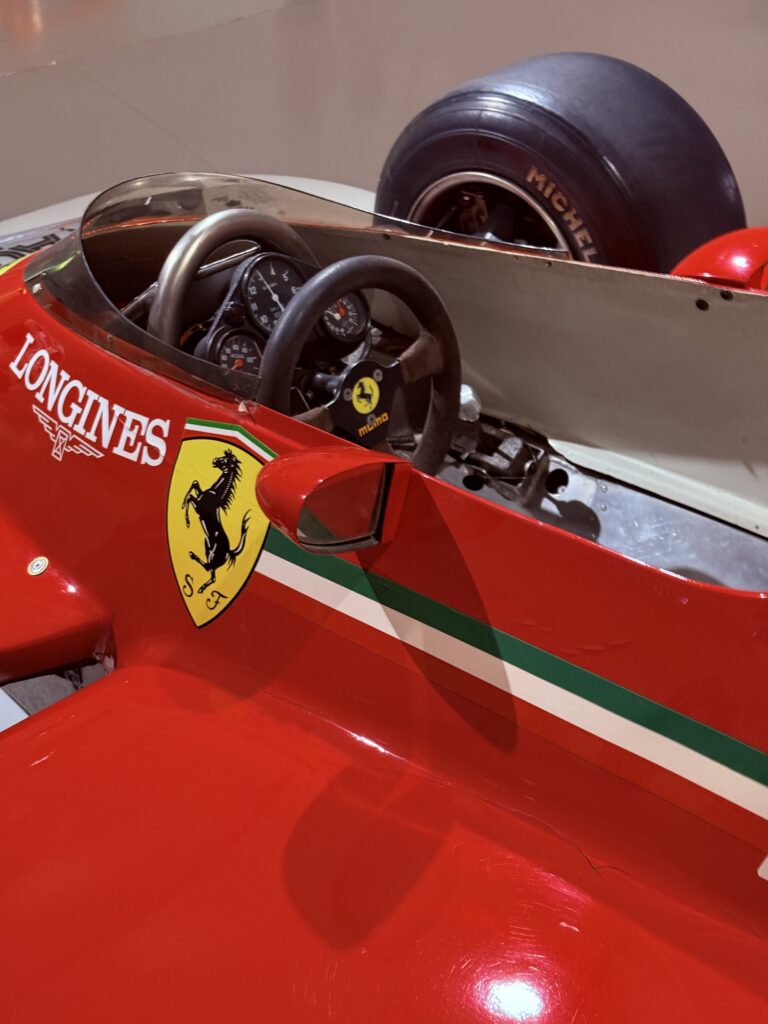


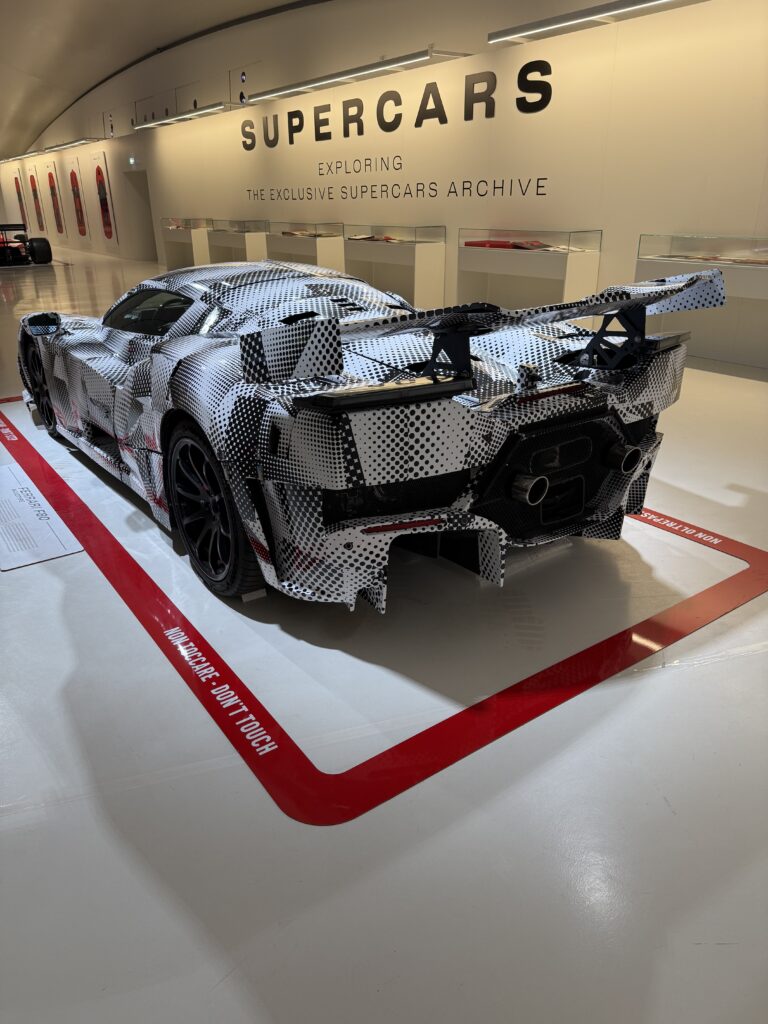


Within the Enzo Ferrari Museum there’s an immersive experience unlike anything I’d come across before. At set times the lights dim and the entire museum transforms into a theatre – the sweeping curved walls of the building becoming one enormous, wrap-around screen. A film charting Enzo Ferrari’s life then plays out across the walls all around you, while you stand below among the cars taking it in. It traces his story from his early days in Modena through the founding of the marque and the rise of Ferrari into the icon it is today. Standing in the middle of it all, with the story unfolding around the walls above you, it was a genuinely moving way to take in just how much one man’s vision had shaped not only a company but a whole piece of motoring history.
I could have stayed there and geeked out over all the details of the cars for hours. How often do you get the chance to be able to see these cars up close and in detail. Classic F1 cars, modern supercars like the F80, vintage F40 race cars, a 288 GTO (one of my all-time favourite cars), just to name a few. I was like a kid in a toy store and didn’t want to leave.
We took the shuttle bus over to the Maranello museum, which leans far more toward the race cars than the road cars – and it was here that I got my big chance. Tucked among the exhibits was an F1 simulator, and I climbed over the side of the cockpit, the attendant lifting the halo out of the way, feeling every bit the driver about to be discovered. I settled on the Imola circuit and told myself this was it: put in a few blistering laps, prove I had the pace, and surely a Scuderia contract would be waiting for me at the end of it. I could already picture the phone call. After a handful of laps the attendant came back with a sheet of paper – my lap times printed in black and white, the evidence of my talent. Ferrari’s people would be in touch any moment now. Somehow, though, the contract never came. I can only assume they lost my number. It was probably for the best – they’d have to tear up either Lewis Hamilton or Charles Leclerc’s contract and all that travelling the F1 drivers do seems awfully tiring.


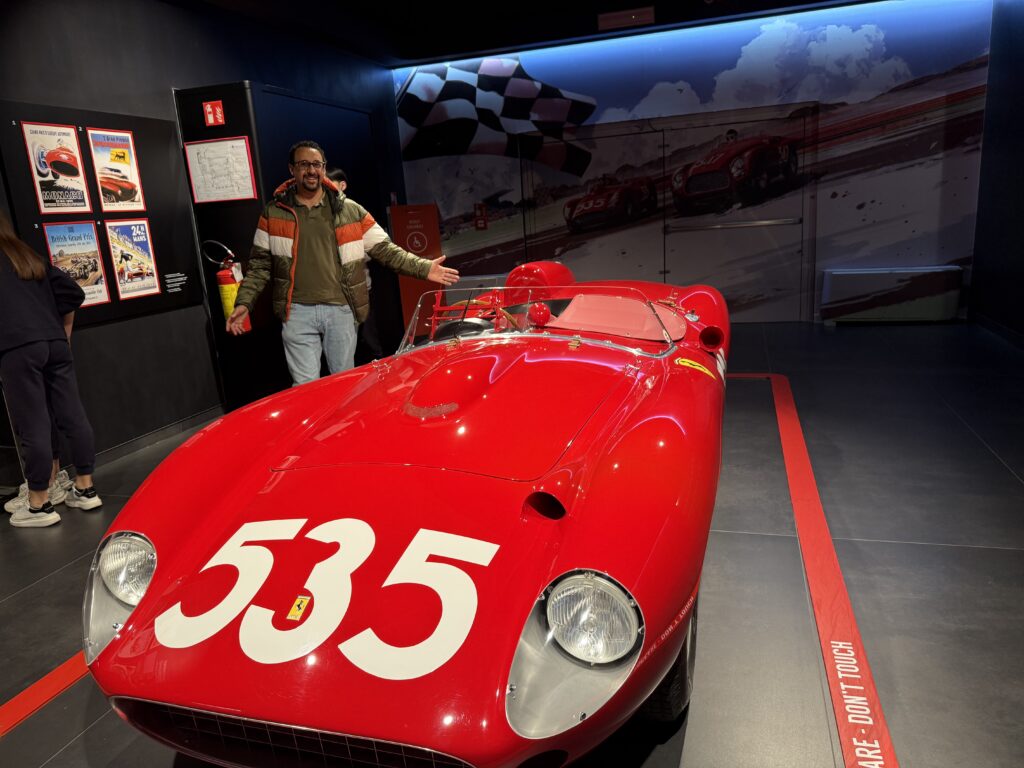
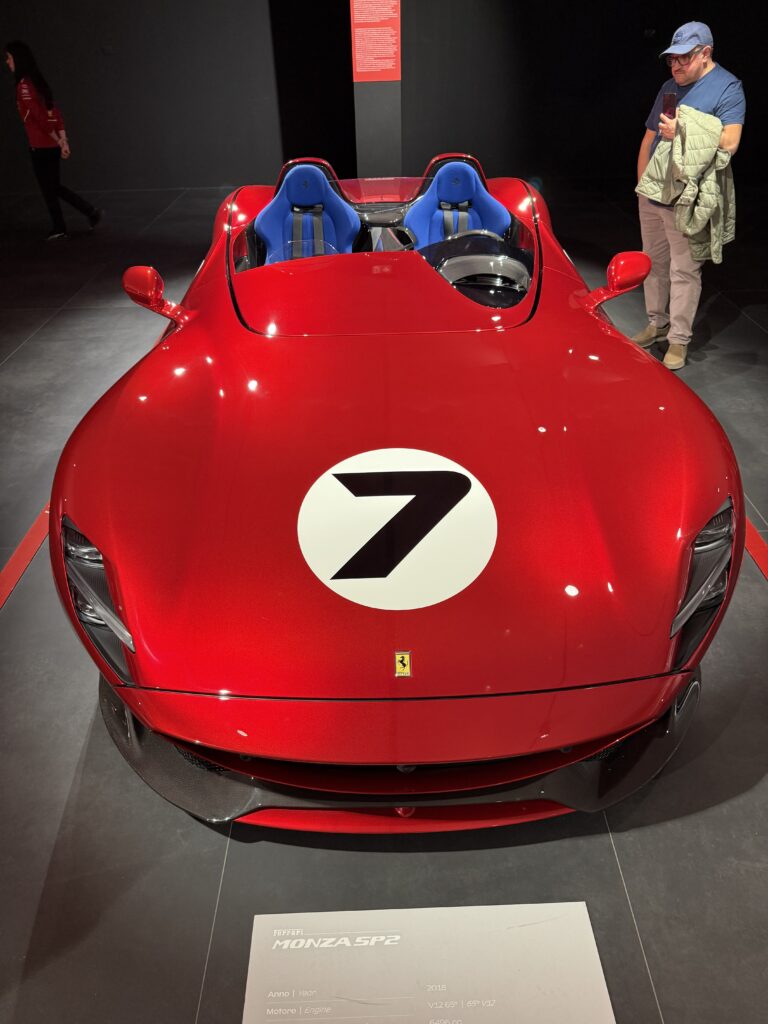


The following day saw us drive out to Sant’Agata, the home of Lamborghini. We arrived at the Lamborghini parking lot and were immediately stopped by security. We were driving a particularly conspicuous Mercedes amongst the carpark full of Audis and Lamborghinis, so we obviously didn’t fit in there. The security guard kindly told us that we’d need to look for parking at one of the carparks up the road which we came to find out were all full to capacity. After driving several laps through the carparks and neighbouring streets a local gentleman spotted us and kindly offered to let us park in the gated off field. He was the chef / owner of the local restaurant and we were definitely planning on coming back for lunch.
We then did our tour of the Lamborghini museum. It’s a much smaller venue than what Ferrari has, but Lamborghini doesn’t really have the motorsport heritage of Ferrari either. Still, we got to see some rather rare models that I’d never seen in person before like the LM002 and the 350GT – the first Lamborghini ever and an absolutely gorgeous car.


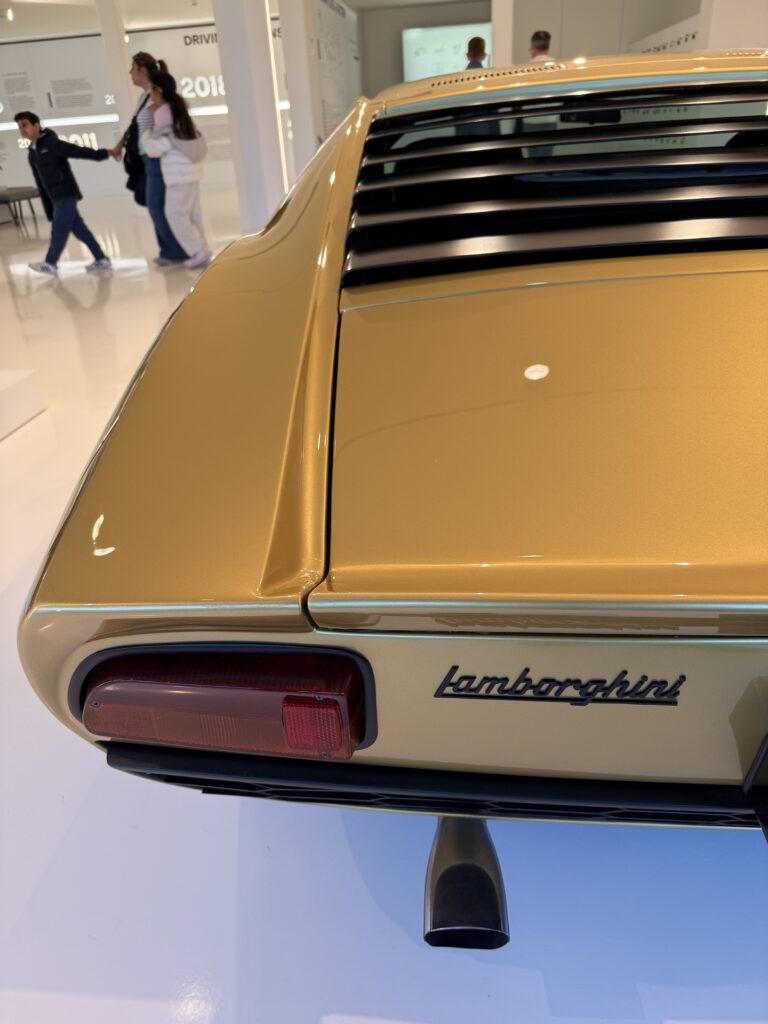


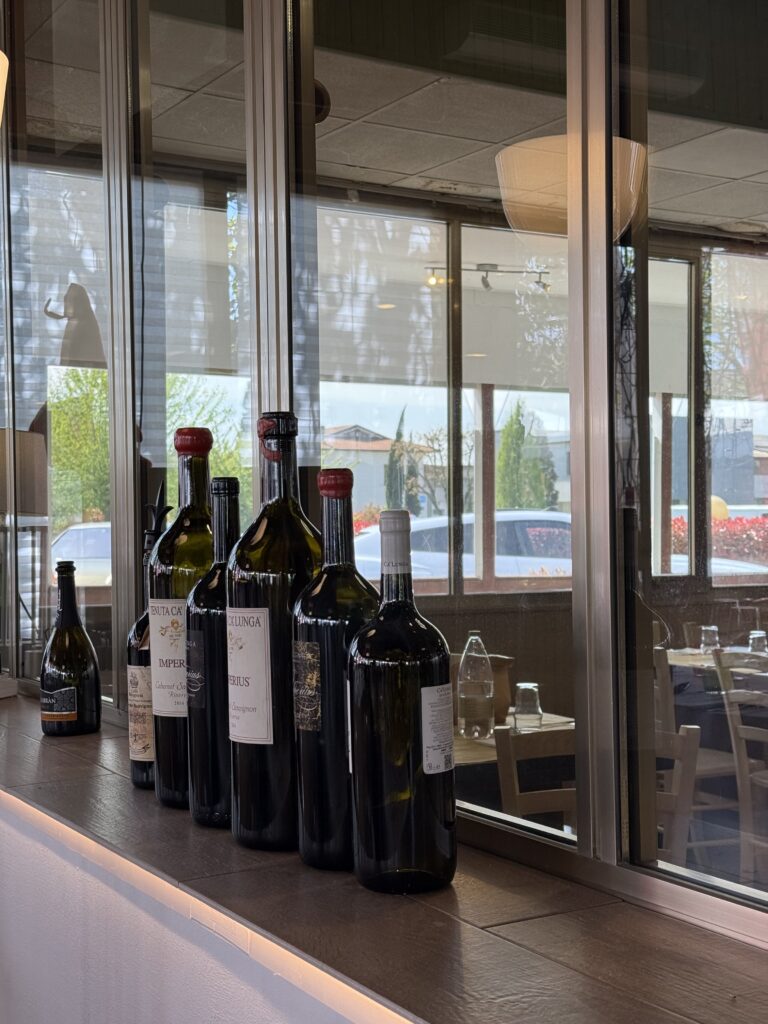
The kids were starting to get restless so we decided to head off for some lunch. Naturally we headed to the restaurant where we had parked our car earlier. We arrived to find several Lamborghinis parked at the entrance that had arrived just before us. As it turned out we were seated at the next table from them. It turns out that this restaurant was a little special. It was decorated with lots of Lamborghini memorabilia, like a Lamborghini V12 engine near the entrance and seems to be the place where the execs come for lunch.
Now I don’t speak any Italian, but I do understand tone and couldn’t help overhearing part of the conversation between the 3 Lamborghini execs. The conversation went something like this:
Gentleman 1: Made a statement, an announcement!
Gentleman 2: Clearly asking a question, he wanted more info
Gentleman 1: Ferrari!
Gentleman 3: Bernardo! Nooo!
What did Bernardo tell them? Did he resign? Did he tell them that he thinks Ferrari does something better? I need answers! Unfortunately, I may never know. The meeting ended abruptly at that point, the trio got into their Lamborghinis and drove off, and somewhere in Sant’Agata there’s a man named Bernardo with a story I would genuinely pay to hear.



Tuscany
With that our time in Modena came to an end and we headed to our next stop in Tuscany. Tuscany was an absolute dream. We stayed in a tiny village named Greve in Chianti. This was a village that was designed around a horse and cart, not a Mercedes GLE. The drive to Greve was simple enough heading down the Autostrade, but then we had to make an abrupt hairpin turn (where there was always a car precariously parked) and start navigating our way up the mountain through the tiny village streets. When I say tiny streets, I mean tiny. One of the hairpin turns couldn’t be navigated in a single turn if it wasn’t taken just right, most of it was single lane, something that didn’t seem to bother the locals as they always seemed to find space to get past and of course there was no armco or barrier of any kind as we made our way up the mountain.
But then we turned off the dirt road and found our way into a postcard – Il Colle. We entered the gravel driveway lined with potted geraniums and citrus trees leading up to a stone cottage that we found out was over 600 years old. We then met up with our host, the delightful and charming Giovanni. He greeted us with a bottle of his house Il Colle Chianti Classico and some antipasti which we gladly devoured as he told us about the property and lifestyle.


In Italy, he explained to me, they don’t just eat dinner. “You have to savour every moment.” From 8-10pm every night the family gathers for dinner. It’s not just about eating a meal, the meal is the moment they share together every night. He then went on to explain that the property with its rolling fields of olive groves and grape vines is a lifestyle. If he did it for the money, it’s just not sustainable. It’s long hours and the whole family contributes to it. His mother looks after the winery, Giovanni looks after the tourists, his father farms the olives. They have a concept of Agriturismo and they need tourists like us to stay afloat. We spent quite a bit of time with Giovanni over the next few days of our stay as I came down with a cold, but the kids were delighted to be able to spend time in the pool and hot tubs.
While we were in Tuscany I received an email from my agent, telling me I’ve scored an audition for a TV commercial. I had to get up at 4:00am to take a video call to my audition online. The casting director immediately knew where I was when she saw the background. The exposed beams and lowish ceiling was a definite tell. I had to explain that I was in Tuscany and we had a good chat before the actual audition. It went really well, and I made the shortlist, but unfortunately, I didn’t get the part. Maybe I should take some acting lessons.
We took a day trip from Tuscany to Florence to meet some friends. This was actually the catalyst for us taking this trip, since one of our friends was having a milestone birthday and wanted to celebrate in Florence. We explored the markets, had lunch and visited the Uffizi Gallery. I love looking at the detail on many of these artworks and could have spent the whole day there, but the kids were getting restless which meant we had to rush through most of it. I’m still grateful to have been able to see it. We also got a chance to see Michelangelo’s David and the Accademia Gallery.


Returning from Florence, I was now getting comfortable in the GLE. It had been my daily drive for over a week and I was feeling more confident, particularly through the winding country roads that linked Greve to the Autostrade. I found myself more confidently pushing the car looking for the apex, braking a little harder through some of the sharper corners and pushing the throttle with a little enthusiasm whenever I could. It was a real credit to the Mercedes how smooth and relaxed it felt during spirited driving. For such a big car with high centre of gravity and a diesel engine of all things, it was remarkably well composed. It just did what I asked of it with plenty of power in reserve and minimal body roll.
Just as we entered the village of San Polo in Chianti, my 7-year-old son exclaimed “I’m feeling sick!”. Oops, it looks like my spirited driving may have been a little too much. I stopped the car the first chance I could and … I’ll spare you the detail. Fortunately, it all took place outside the car. One of the local restauranteurs saw us and offered a bottle of water for my son. That’s Italian hospitality, they’re always looking to help where they can. We continued on at a much more leisurely pace and made it back to our apartment in Greve.

Sorrento and the Amalfi Coast
We were sad to leave Tuscany as our host Giovanni and the accommodation were just outstanding, but we were getting ready for the next leg of our Italian dream. We were now heading for Sorrento. We packed the GLE and headed back onto the Autostrade. By this point I was comfortable driving down the Autostrade and knew which lane to take at the toll booths. We’d look for the biglietto sign, which translates to ticket, get our ticket checked and pay our toll by card. We then entered Sorrento.
Sorrento was a beautiful coastal retreat, but it was not made for the GLE. In a town where everyone is driving microcars, the GLE felt like a bus. It was longer. It was wider. It was taller than just about every other vehicle around. On the narrow winding roads it was quite challenging, especially with the local scooter riders weaving in and out of traffic. At one point, I’m sure a scooter rider made contact with our front left tyre as he was trying to pass. I definitely felt a jolt in the steering as he entered into my blind spot, but he continued on as though nothing had happened. Fortunately our apartment came with a parking spot as finding parking in Sorrento is not easy, especially for a car as large as the GLE.
We arrived at our apartment and met our hosts Francesco and Anna. I’m not sure if they’re a couple or just coworkers, but they went above and beyond for us. They manage several apartments in Sorrento, but still managed to give us personal service and made us feel like we were their most important visitors.
We decided to head out and explore the town and got no more than 500 metres from our apartment when my wife twisted her ankle. She was on the ground in tears and really struggled to get up again. The concierge from a hotel across the road saw what happened and came to our aid with a couple of cool bottles of water, while a couple of police officers who were in the area also helped. The concierge helped us into the lobby of the hotel and told us we could stay as long as we needed to freshen up. They even got an ice pack for her ankle. But this isn’t where the Italian hospitality ended. My wife was struggling to put weight on her ankle and so we called our only contact in Sorrento – our host Anna. She showed up a few minutes later with her car, helped my wife into the car (a 2 seater Smart car) and took her to the hospital. I walked over with the kids. Once we were at the hospital, Anna arranged for a wheel chair and spoke with the hospital staff. The emergency department was a little different to what we have here. It’s literally a window in a hallway, no seats and you just need to wait your turn.
After waiting for an hour or so, Anna returned to check up on us. We were still waiting to see a doctor, but my wife was starting to feel a little better. We decided it wasn’t worth waiting any longer and Anna took my wife home. The kids and I would have to walk back – about a 20 minute walk all up. On the way back, the kids were nagging me for some ice cream, so I thought I’d make a quick stop and give in to their demands. We’re now walking back and just around the corner from the apartment, gelato in hand when we see Anna who had just left my wife. I have to admit, it must have looked bad to Anna. She’s dropped everything to make sure my wife was OK, while I was out enjoying gelato with the kids. The look on Anna’s face said a lot. I still joke about this with my wife.
With Sorrento as our base, we had a couple more day trips left in our Italian dream. Firstly, we made a trip to Naples. Back in the GLE, through the Sorrento tunnel, onto the Autostrade and we’re in Naples. Naples unlocked a level of driving anxiety I didn’t even know I had. Traffic in Naples doesn’t follow traffic rules like we do in Australia. Traffic in Naples relies on intent. There’s unwritten rules and expectations that mean you don’t wait for someone to give way or let you in, you show your intent and as long as you don’t make any sudden movements, everyone’s OK with it. For example, in Australia if you want to make a right turn, you turn on your blinker, wait for clear traffic or possibly for someone to give way and then you make your turn. In Italy if you want to make a left turn, you turn on your blinker and start heading towards where you want to go. No sudden movements, no sudden braking, just aim and go. Everyone around you gets what you’re trying to do and deals with it. It sounds chaotic, and it is, but somehow it works.
We tried to find a parking space in the centre of Naples and found a car park, but there was no way we were going to fit the GLE in without scraping on something, so we decided to park just outside of town and catch a taxi in to the historical town centre.
We walked through the lane ways and found a delightful pizza restaurant. Next to us a street vendor was creating a spectacle selling “limonata a cosce aperte” or “open legs lemonade”. It’s a post-meal digestif that consists of fresh lemon juice, sparkling water and a spoonful of baking soda. When combined, the ingredients create a violent and rapid foaming reaction. To avoid spilling the exploding foam on their clothes, drinkers must chug it quickly while bent over with their legs spread apart. I was tempted to try one until I saw the street vendor try to kiss every man that bought one.

One thing that really stood out in Naples is how much they love Maradona. They revere him to almost saint-like status due to his 7-year stint with SSC Napoli from 1984-1991. To this day they still hang his picture up in the streets and sell his old football jerseys.


The next day saw us taking a day trip to Amalfi. We considered taking the trusty GLE for this, but were told the roads around Amalfi were even worse so we decided to take the bus. And thank goodness we did! There was no way we could have got through Amalfi without damage. The roads are tighter and there are large buses coming through at the same time. There’s only 1 road in / out of Amalfi, it’s on the side of a cliff (with no guard rail) and it’s barely wide enough for a single car, although somehow 2 buses can pass each other.
Transport worries aside, the day wasn’t quite what we were hoping for. It was a little cold and a little wet so the sort of things you’d normally do in a nice seaside town weren’t really possible. We ate some pretty ordinary food, browsed some of the shops and took the kids down to the bay for a bit of a play. It may have been wet and cold, but kids will be kids and they always find a way to enjoy themselves. They had a great time exploring the water’s edge and dipping their toes in the water in spite of the gloomy weather.


It then came time to leave and that meant getting onto a bus back to Sorrento. I now understand why the Romans built the Colosseum. The unwritten history. It was a bus stop and the gladiators would fight to the death to secure a seat home. It was a blood sport where only the fittest and strongest survive. You have 500 people waiting for a bus, which could come by any of the 5 or so bus stops at the terminal. There’s no set times, but only about 1 per hour. It’s a battle of the fittest to get on. After missing the first 2 buses we were told the next one would be the last for the day. I told my wife to stay close as I’m about to go full Roman Gladiator. The bus finally came, I was primed and ready to push my way forward. The door opened, I grabbed hold of my son and made my way onto the bus and luckily found a seat for us towards the back of the bus. My wife and daughter almost didn’t make it on, she told the driver I was on with my son and she was not letting the bus go without them. He let her on, but unfortunately there was no way she was making it to the back of the bus to the seat I had saved her, so I let it go to another passenger. I’m definitely counting that as a win.
As we were returning from Amalfi our bus driver had more than his share of trouble getting through the narrow roads and tunnels. First he had to stop to let a lady in a micro car pass, that wasn’t so bad except that she wouldn’t go past until she had lots of space. Our bus driver had to reverse with no rearward visibility. There was a car parked against the mountain face that he totally wiped out trying to reverse, all so this microcar could get past. He stopped the bus took a look at the damaged car, then shrugged his shoulders and carried on. Until we got to the next tunnel where he had to make space for another bus. It took about 20 minutes with the other bus driver guiding ours forwards, backwards, left, right to make just enough space for the 2 buses to pass. They were millimetres apart but somehow did it. Surely this can’t be a daily occurrence?
We decided to get off the bus a stop early and check out Positano, even though it was already dark and we wouldn’t be able to see much. It felt a lot like Sorrento. We wandered the streets and had dinner before trying to head back home. Only problem was there were no more buses. The only way to Sorrento was a taxi at €150 for a 15-minute ride. We asked the concierge at a local hotel where we could catch a taxi and they offered to take us in the hotel limousine for €200.
We eventually negotiated with a local taxi company for €100 and were able to make our way back. The taxi? A brand new Mercedes-Benz Vito! The Vito vans are quite a common sight in Italy. Our airport transfer came in one, but it was a rather old model with more than its share of rattles – it felt like a commercial van with seats in the back. But this new one felt like a luxury car. I suspect if we paid €200 to the hotel, this is what they would have arranged for us.

Our final day in Sorrento was all about taking it easy. We spent it eating gelato, strolling through the town square, and making the most of the local food – starting with a lazy wander and building up to an amazing dinner at a waterside restaurant. We sat looking out over the bay as the sun dropped, the water turning gold and then a deep pink, with the lights of the town flickering on across the water. Steak, seafood, risotto, an Aperol or two: we ate our way through the whole evening as the sky slowly faded.
After dinner we strolled back towards our apartment, and by chance walked straight into the Good Friday procession making its way through the town. It turned out to be quite a thing. Rows of locals in black hooded robes moved slowly through the streets by candlelight, carrying statues of Christ and a grieving Madonna, while a choir sang low funeral hymns that seemed to hang in the air. The whole town had come out for it.

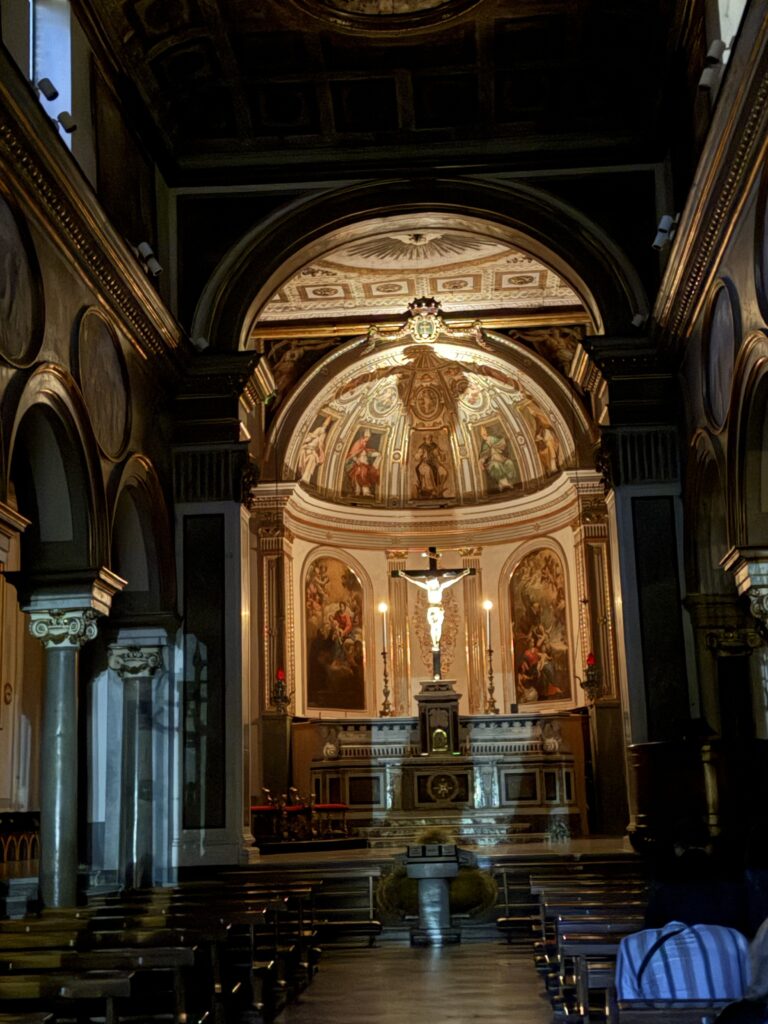
For us it meant more than it might have to other passersby. As Coptic Christians we mark the same day, mourning the same Crucifixion – and in 2025 our calendars happened to align, so it was quite literally our Good Friday too. There was something quietly powerful about seeing it observed here in a different language and tradition but with the same weight of feeling behind it. We stood and watched for a while – the flickering candles, the slow shuffle of feet, hundreds of people following in near silence – a little awed to have stumbled into something so old, and so familiar to us in spirit, before quietly making our way home.
The following morning we packed our bags and checked out of our apartment. The Sorrento leg of our trip was coming to an end. We were set to return to Rome for a few days before leaving Italy and returning home. But first we needed to do something about the car, for although we had parking, it was in the middle of an orange grove and the car was covered in sap, bird droppings and lots of dust from our previous stay in Tuscany. Now ordinarily I wouldn’t worry too much about a dirty rental car, but the rental agreement did have a clause in it about returning it clean and I didn’t want to risk it. So a quick trip to the automatic car wash in Sorrento was in order before heading back to Rome.


With the car now free of Sorrento sap and Tuscan dust, we set off for the final leg of our journey back to Rome. We dropped our luggage off at our apartment then anxiously made our way to the car rental return. I had heard mixed reviews about this particular rental company online, so I was a little concerned that they would “find” something on return. The attendant did a few laps of the car then pointed out the gutter rash on one of the wheels. “This isn’t on my condition report. You’ll need to pay for that”. It was a good thing I took lots of photos earlier – I showed him the pictures from when I picked the car up and he replied “OK. No problem” and took a photo of my photo from his phone. With that, the car was returned and no extra fees were added. Phew! I later realised that I showed him a picture of the wrong wheel, but did find the correct picture. He said it’s OK and moved on.
Back to Rome
We were now well into the Easter weekend, and being a Jubilee year, we decided to spend our last few days visiting Rome’s religious sites. The mood around the city was subdued, though. The Pope was living out his final hours, and would pass away on Easter Monday. Out of respect, many of the Jubilee celebrations that had been planned across Rome were quietly cancelled, and you could feel the sombreness in the streets – a city holding its breath.
Over those last three days we made our way through Rome on foot, visiting ancient churches and standing in awe of the relics they house. Some of them stopped us in our tracks – an original nail said to be from the Crucifixion, fragments of the True Cross, even the wood venerated as the crib in which the infant Jesus was laid. For us, as Coptic Christians, there was a particular weight to seeing these things during Holy Week of all times, in a city moving through the same story of death and resurrection we hold at the centre of our own faith.


Looking back, there was something fitting about how our journey ended. We had set out chasing cars and coffee, fast trains and lakeside views, and somewhere along the way the trip had quietly turned into something more. From the Good Friday procession winding through the streets of Sorrento to these last hushed days in Rome, we had followed the rhythm of Easter across the length of Italy – and by chance found ourselves in the heart of the Catholic world at one of the most significant moments it had seen in years.
We flew home tired, our heads full of everything we’d seen and our hearts a little fuller too. It had been a trip of contrasts – ancient and modern, sacred and everyday, the thrill of the road and the stillness of centuries-old churches. Italy had given us far more than we’d gone looking for, and we left already knowing we’d be back.


